
3 JANUARY 2023
Digitalization: The baseline for a modern business

While the entire finance industry – especially wealth and brokerage firms – have already put great efforts, time and money into digital transformation in recent years, the need to continue focusing on further digital developments will not stop any time soon. Innovations continue at pace and businesses will need new technologies to improve their services and stay competitive.
As well as simply coping with the technological change already underway as businesses adopt tools such as cloud computing, blockchain and AI, it’s important to look in-depth at some of the ways this will impact employees and customers.
We’ve identified two key areas of interest for wealth and brokerage firms in 2023:
- Firms will need a strong digital capability internally to enable their teams and find the tech-savvy employees of the future
- As huge amounts of wealth is transferred to younger generations, wealth managers will need new tools and engagement strategies to attract these customers and adapt services in order to retain over the long term
Digital transformation 2.0
Sources say Digital transformation 2.0 — or DT 2.0 for short — is the inevitable next step in the continuing advance of technological innovation. One focus will likely be on leveraging artificial intelligence (AI) and machine learning to enable more accessible services, greater process automation as well as constructing lean systems to cut the costs and time of such transformation.
Some major technical trends we see in the market in 2023 are:
- Cloud computing: With the rising cost pressure and development in other sectors, more and more company will use virtualized infrastructure as a service (IaaS) over the internet
- Internet of Things: As a facilitator providing connection of physical devices, vehicles, buildings, and other items—embedded with electronics, software, sensors, actuators and network connectivity the IoT will be essential for the digital transformation in various areas. On example could be customer service through technology tools like chatbots or virtual assistants like Siri or Alexa
- Big Data Analytics: The process of digitalisation creates vast amounts of data that need to be analysed in order to build comprehensive profiles and understand how customers interact with their products or services
- Artificial Intelligence as a form of machine learning to make forecasts and to streamline processes
- Blockchain: Being mainly linked to cryptocurrency, blockchain is a secure and transparent way of storing data. It's a decentralized database that maintains a growing list of records called blocks
- Efforts in regulation such as to ensure data protection, anti-trust rulings and in connection with ESG
Finding the talent you need – How digitalization shapes the HR process
As we have seen, new developments, new regulations and changes caused by the pandemic changed the landscape dramatically for all businesses. They have also changed the workplace. The coming years will heighten the need for new technologies and solutions to enable more personalized and connected offerings. Remote or hybrid work has also really taken centre stage with more and more businesses allowing employees to take advantage of flexible work environments. As a result, collaboration-focused services have released new features and adjusted platforms to make working together easy, seamless, and equitable regardless of location. These changes require specialists to develop and deploy such services.
Let’s look at some examples of the major recruitment challenges facing employers in the finance sector.
Finding talented staff able to understand both the nuances of finance as well as the evolving advancements in technology is an increasingly difficult challenge for employers.
Financial services companies need to acquire talent with new skills to remain competitive, such as:
- Artificial intelligence and machine learning
- Cybersecurity
- Data science and data analytics
- Software development
- Cloud engineering
- Risk management and modelling
Employers need to change their HR strategy accordingly and be prepared to rethink long-held views about hiring and dealing with their talent pool.
Employer branding strategies will come to the forefront. With the workforce shrinking and more specialized tasks emerging, employers need to attract the talents they need. With now more that 75% of applicants researching the potential employer in detail, a strong brand becomes crucial. The way companies recruit candidates and – even more importantly – retain employees has changed due to technological advancements, social media and career review sites.
Employers can show commitment to work-life integration through a strong remote or hybrid working policy. Companies that ignore the popularity of remote or hybrid work will find themselves struggling not only to hire top talent, but get applications from top talent. During their job search, many candidates filter out jobs that require them to be in the office full time. Additionally, in 2023 more candidates will look for companies that promote work-life integration: being able to put in hours when it’s most convenient and take care of personal responsibilities when needed (such as working a few hours in the morning, taking an afternoon break for an appointment or to pick up kids, then back to work in the evening). Watching the clock will become less important as managers assess success by the output of employees and not the timeframe of their workday.
The renaissance of “corporate values”. With the latest ESG reporting requirements companies must publish their view on ethics and values as well as their diversity, equality, and inclusion strategies. As these become more visible, more applicants as well as customers will start to ask for these.
Training and upskilling offer a competitive advantage. With the fast pace of developments in the working environment, ongoing tailormade trainings have become essential. Businesses need to upskill existing employees as well as continue to train recent hires to fulfil new or changing roles. Offering the opportunity to learn in-demand skills and a clearly structured onboarding processes will add to the employer brand and attract applications.
Infrastructure. With technologies developing so rapidly, employees and internal infrastructure demand and require the same efforts in infrastructure as for customers. Due to the ongoing digitalization and automation, the set of tools you give them needs to adapt too.
Digitalization is key to attract future customers
Generational transfer is already happening every day. The question arising is, are the market participants ready? Do they understand the different needs, expectations and mindsets of the new target groups who to be catered for?
According to Forbes the Silent Generation (those born during or before World War II) and Baby Boomers (born between 1946-1964) will upon their death transfer an estimated $30 to $68 trillion to their adult children and grandchildren. These are the so-called Generation X (born between 1965-1980) and Millennials (born between 1981-1996).
It’s expected that this transfer will transform young consumers into alpha buyers of real estate and other big-ticket items, converting them into great next-gen clients of financial advisors, banks and more. For this amassed wealth – surveys estimate that the Boomers held more than 50% of all wealth and assets in the US economy in 2020 – detailed planning and understanding is vital as tax and regulations concerning donations and inheritance are becoming more complex.
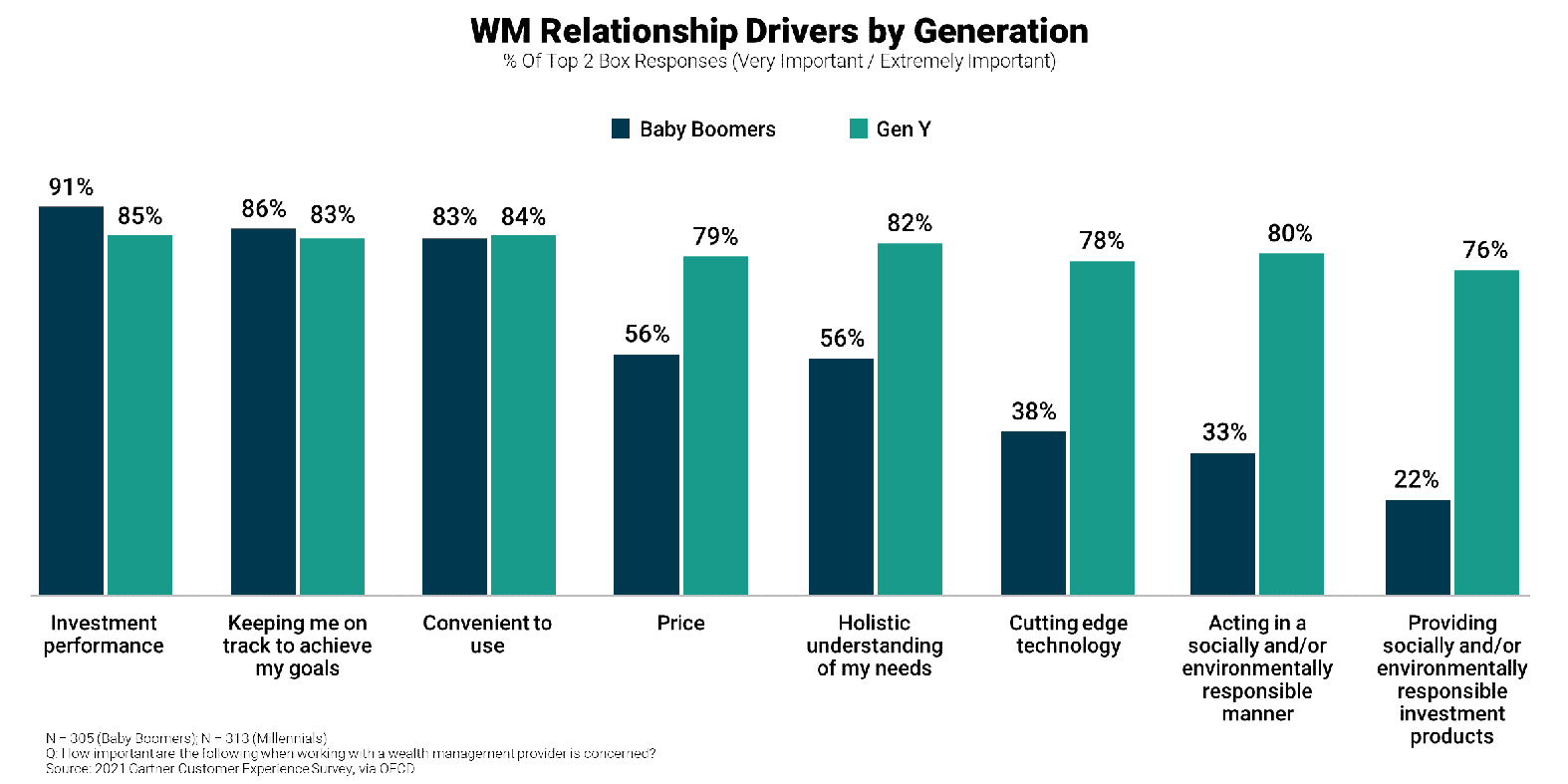
Another issue is the fact that market participants need to be aware that the financial management expectations and methods of Millennials will differ quite a lot from their parents or Gen Z. If advisors can’t cater to those needs, they will lose clients and assets. As a reaction to the fact that most children end up firing the family’s advisor when the wealth holder dies, more companies are starting to adopt multi-generation wealth management.
That requires not only relationship management but also the use of various communication methods and tools. Since the Boomers still hold the majority of assets, they remain in the focus for now. Boomers are today more comfortable with technology, so offering simple and engaging digital solutions can help firms to be more effective and improve advisor efficiency. Still, they need to satisfy the preference of many Boomers for face-to-face interactions when making key financial decisions.
Younger generations of investors educate themselves and conduct some research before choosing their advisor and their asset. For them, financial literacy is a given factor and they often want to use their assets to finance change. This change in mindset that characterizes this generation is also reflected in a shift in investment habits towards products that consider environmental and societal issues such as ESG. It’s this change that is forcing wealth management companies to rethink their offer, their client experience and their advisory strategy in order to appeal to Millennials.
But they are not the only ones. Gen Z is also part of the story. Due to age difference their thoughts on the biggest pitfalls and opportunities that investors face today differ quite a bit from the Millennials – something CFPs and asset managers need to be aware of.
More than half of Gen Z adults are already invested – with 26% of that group invested in the stock market – yet only one in four feel they understand the stock market well enough to explain how it works to a friend. Of all financial concepts, they feel most confident on spending and saving. Because of these diverse client groups, advisors and wealth managers need to develop client experiences and customer journeys that match not only the expectations of digital natives, but also those of digital beginners. Moreover, the advice and the underlying tools need to reflect the level of financial understanding of this diverse customer group.
Providing digital tools and channels for client communication has become one of the key factors in gaining and retaining new-gen clients. As digital natives, most younger clients prefer digital business models delivering personalized and intelligent financial advice at scale – like their self-service banking channels.
With the increasing use of interactive chat bots and AI it is still vital to keep up a human-centred design to give customers access to human advice when needed. The pandemic as well as the ongoing uncertainty and volatility of the market as well as fears over long-term inflation have underscored and amplified this evaluation, leading more clients to seek human counsel from wealth managers.
With all the new regulations and reporting requirements the investors of all generations ensure a rising need for environmental, social and governance (ESG) products. Considering ESG issues as part of financial analysis has become an important motivation – for investors and for advisors.
Another investment trend that has grown significantly are ETFs and cryptocurrencies. The demand for digital assets has grown enormously in the last couple of years meaning advisors and wealth managers need to be sure that they can facilitate the advice as needed and to use the according tools. When the regulatory direction becomes clear, advisors will need to build an extension of their current capabilities and processes.
All this means rising costs and a huge investment of time. Since the new developments and regulations are often evolving at the same time, advisors of all sizes and sorts need to make sure they are in the loop and aware of coming trends, obligations and needs.
This is why digital solutions for advisors will become more important for wealth managers. Through integration of the proper tools into existing processes and systems, wealth managers must be able to get instant answers to regulatory questions or product details – when and where they need it – so they can focus on advising their customers and as a result produce quicker turnarounds.
Key takeaways: Infront’s view on digitalization in 2023
- Digital Transformation is never done, so while we’ve invested in being more data driven and flexible in the last few years, you need to keep embracing new digital opportunities
- Life has changed over the last three years for your and everyone else’s teams as remote working has become common. We’ll all need modern tools and employment practices to attract the next generation of talent
- With huge amounts of wealth being transferred to younger generations, you’ll need new tools and engagement strategies to attract them to your services and keep them over the long term
If you want to know more about the latest developments in relation to digitalization, please refer to:
The 5 biggest technology trends in 2023 everyone must get ready for now – Forbes
10 future IT trends & predictions for 2022/2023 you should be thinking about – Finances Online
Top 5 technology trends for 2023 – BearingPoint
If you want to know more about the changes in the HR world linked to digitalisation, please refer to:
Talent acquisition trends 2023 – Korn Ferry
10 recruitment trends for 2022/2023 – Finances Online
Filling in the skills gaps in financial services – The Banker
10 recruitment trends to keep an eye on in 2023 – Human Resources Online
Recruiting trends to watch in 2023 – Untapped
If you are interested in a deeper understanding of the investment’s trends and generation transfer, please refer to:
The future of wealth in the United States: Mapping trends in generational wealth – Deloitte
Wealth management: 8 trends for 2022-2023 that should not be ignored – Kee System
6 golden financial planning rules for millenials – Forbes
From Investing To Budgeting, How Millennials Are Disrupting Personal Finance – CB Insights
How to navigate the great wealth transfer according to top advisors – CNBC
Generation Z: Stepping into financial independence - Investopedia