

15 april 2026
From PRIIPs KID to CCI Product Summary: What Fund Managers Need to Know Before 2027

The UK’s switch from PRIIPs KIDs to the new Consumer Composite Investments (CCI) regime is more than a technical update. It’s a fundamental reset in how the industry communicates investments to retail clients.
For fund managers currently producing only PRIIPs KIDs, the next year will reveal whether CCI becomes a compliance burden or a catalyst for better data infrastructure, governance and client communication. The transition window is now open and full mandatory compliance lands on 8 June 2027. That is a tight timeframe to rethink your disclosure processes from the ground up.
From Template Thinking to a True Product Information Framework
Under CCI, the FCA replaces rigid PRIIPs and UCITS KI(I)D templates with a principles-based Product Summary. It mandates standardised core content (costs, risk, performance) while offering significant flexibility in design and delivery. The scope is broad: open-ended and closed-ended funds, insurance-based investments, structured products and other retail investments all fall under the regime when marketed to UK retail investors.
This evolution aligns with the UK’s broader retail disclosure strategy. The direction is clear: move from box-ticking to genuinely decision-useful information, consistent with Consumer Duty principles around customer understanding and price-and-value outcomes.
Rather than being yet another PDF, the Product Summary should be proof that products have been designed, priced and communicated to deliver good outcomes for retail consumers.
The CCI Transition: Open Until 8 June 2027
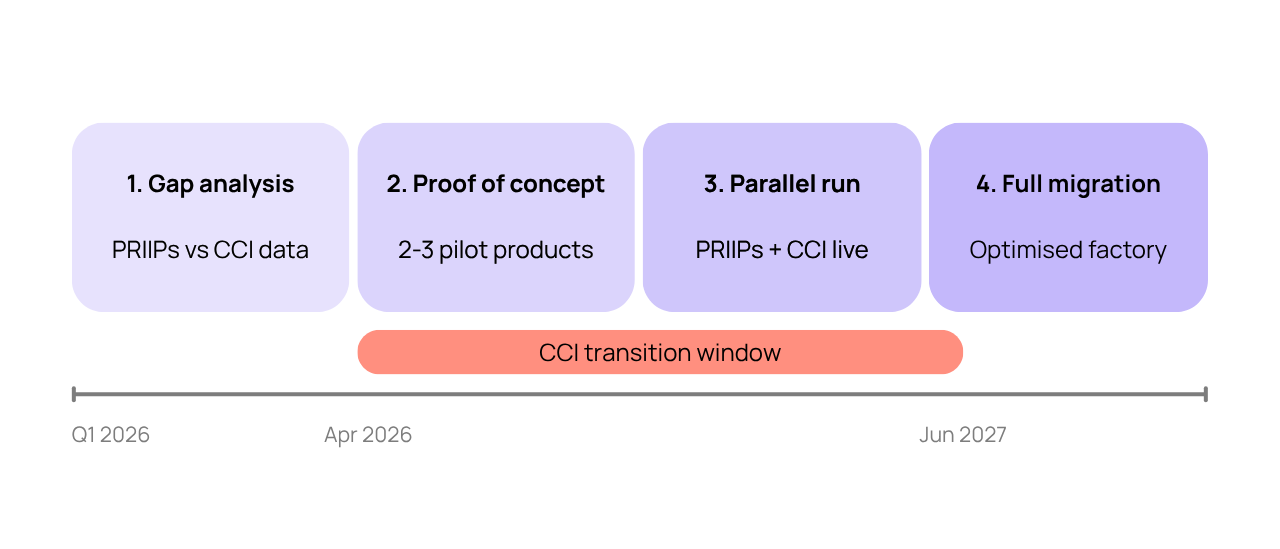
The FCA’s final rules established an 18-month implementation period starting 6 April 2026. Manufacturers can now switch product-by-product between UK PRIIPs/UCITS disclosures and the new CCI Product Summary. By 8 June 2027, all CCIs marketed to UK retail investors must use Product Summaries. UK PRIIPs KIDs and UK UCITS KIIDs will no longer suffice.
Three strategic questions to help PRIIPs-only fund managers structure their transition:
- When do you migrate which products? Do you go early for UK-focused ranges, or hold out until 2027?
- How do you run CCI alongside existing PRIIPs engines without duplicating work?
- What should the Product Summary achieve beyond compliance for distributors, advisers and end-clients?
Hidden Complexity: Costs, Performance and Risk Score
The shift from PRIIPs templates to flexible Product Summaries might look simple on the surface but the real challenges will be in changed content requirements, data sources and methodologies.
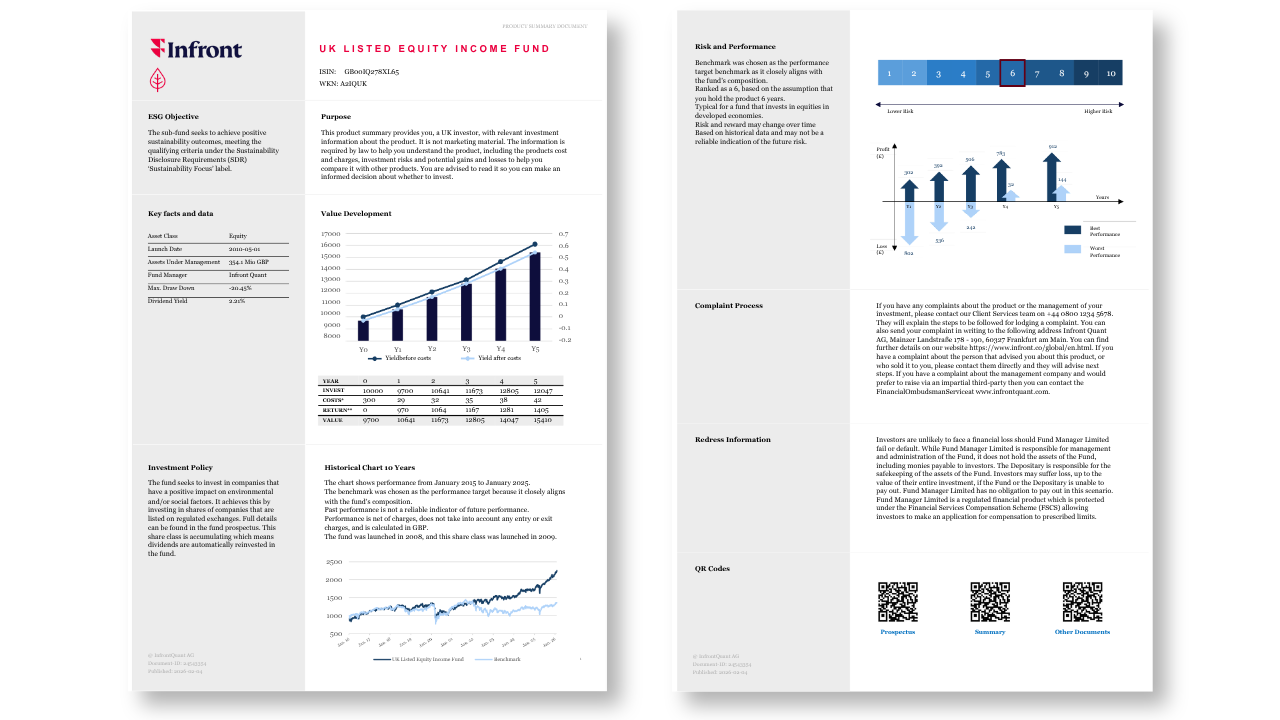 Example Product Summary document
Costs and Charges
CCI requires ex-post costs from fund accounting as standard (with exceptions only for misleading or fixed costs). Costs must appear in both percentage and GBP terms, based on a £10,000 investment. Implicit transaction costs disappear; the three-year average remains. Performance fees appear only as methodology, not as the PRIIPs five-year average. Indirect costs require look-through to the first underlying level.
Performance
The metric stays the same: net performance with dividend reinvestment. But the visualisation changes. CCI mandates line charts instead of bar charts, always on a £10,000 basis, with up to 10 years of NAV and benchmark data. The latest price must be no more than 60 days old. PRIIPs performance scenarios are gone, replaced by consistent UCITS methodology.
Risk Score
CCI uses a simple volatility calculation like UCITS, but over 10 years rather than five. A mandatory score of 9 applies for derivatives, short track records and leverage. A score of 10 applies where losses exceeding 100% are possible, with an additional point for illiquid assets. Where fewer than 10 years of data exist, a bootstrap simulation is required, with documented governance around the process.
The operational reality is stark. PRIIPs-only managers must modernise not just templates, but data architectures (look-through costs, 10-year performance, simulation logic), visualisation engines and governance processes.
The Product Summary as Front-End of Your Data Architecture
Forward-thinking managers will use CCI as a catalyst for broader improvements: standardised calculation engines for ex-post costs, performance and risk across PRIIPs and CCI; a single data backbone for product, market, cost and benchmark data; and flexible rendering for layered delivery across digital channels and multiple layouts.
Think of the Product Summary as the facade of an integrated information architecture. It’s the client-facing layer, but depends entirely on standardised data, models and controls underneath.
PRIIPs to CCI in 4 Steps
Why Talk to Infront Now
The CCI transition period, while PRIIPs still runs, is the right moment for strategic partnerships. Infront is well positioned to help.
End-to-end regulatory data and document production. Ex-post costs from accounting with look-through logic. 10-year performance and benchmark time series. CCI Risk Score calculation including simulation logic and governance rules. Automated Product Summary generation and distribution across PDF and digital formats.
Intelligent reuse of PRIIPs investments. Infront can identify which PRIIPs methodologies (transaction cost model, performance engine) are proven and migrate them into flexible CCI architecture. This enables parallel runs during the transition without starting from scratch.
Demonstrable control and operational resilience. Full audit trail from source data through calculations to the finished Product Summary. Consumer Duty evidence and regulatory inspection readiness built in.
Take action while PRIIPs still runs but the CCI deadline approaches. Schedule your CCI readiness assessment for your UK retail portfolio with an Infront expert.
The transition window is open. Plan now, not in 2027.