

17 July 2026
T+1 Settlement: The Race to Be Ready

In just 18 months, one of the most significant transformations in decades will take effect across European capital markets. As the clock strikes midnight at the start of 11 October 2027, most securities transactions in the EU, UK and Switzerland will require settlement one business day after trade execution rather than two.
The transition from T+2 to T+1 settlement will effectively halve the post-trade processing window that investment firms currently rely on to allocate, confirm, fund, and settle transactions.
The change will bring the EU into alignment with jurisdictions such as the United States, Canada, China and India, all of which have already adopted T+1 settlement. It is expected to improve settlement efficiency, strengthen the resilience of EU capital markets and support the development of deeper and more liquid markets. By shortening the time between trade execution and settlement, T+1 reduces the period during which buyers and sellers are exposed to counterparty and market risk, while enabling investors to receive cash or securities more quickly. In turn, this allows market participants to redeploy capital sooner, enter into new transactions more rapidly and potentially increase overall market activity and liquidity.
A Structural Change in Post-Trade Settlement
However, achieving these benefits will require significant operational change across the investment ecosystem. Once T+1 is in place, firms will have less time to ensure that cash and securities are available for settlement. Funding will need to be arranged earlier, with less opportunity to correct shortfalls. The challenge will be particularly acute where portfolio settlements, FX transactions, subscriptions, redemptions and other funding flows occur on different timelines. This will increase the need for intraday visibility of cash and positions, as even minor timing mismatches will have a more immediate impact on settlement outcomes.
The transition to T+1 will also impact FX handling. At present, firms typically have more time to execute the FX leg after the securities trade while still meeting settlement cut-offs. T+1 will compress this window. Consequently, FX may need to be executed on trade date, particularly where payment cut-offs, custodian deadlines or time-zone differences reduce the effective operating day. This will have a pronounced impact on non-local funding flows and on securities settling in currencies different from the fund’s base currency. It will also increase demand for faster, more automated FX execution and funding processes.
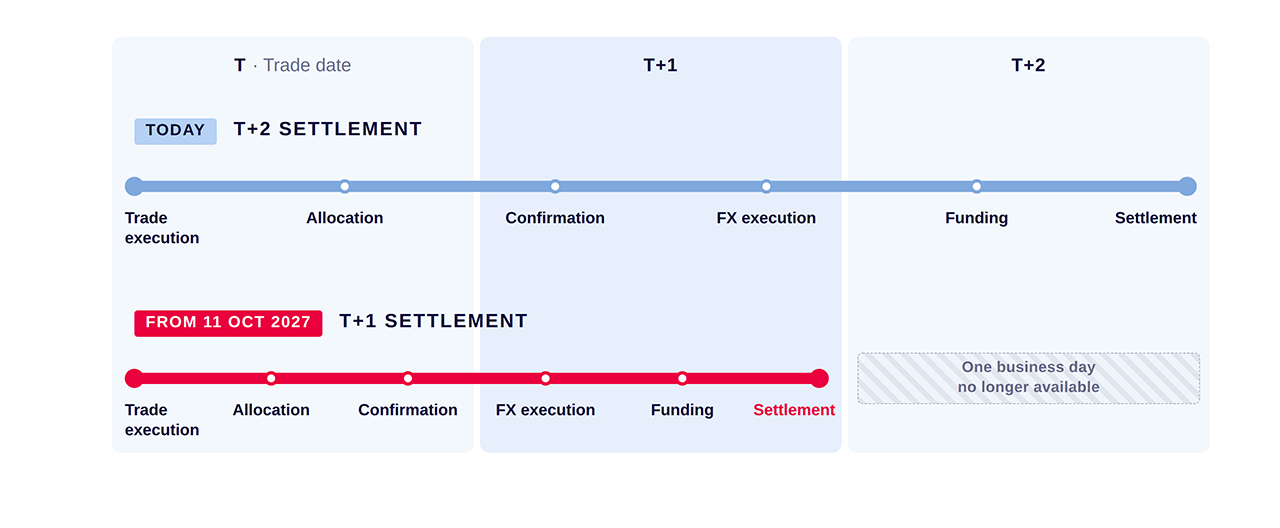 Example of how T+2 and T+1 timelines compare
Closer Cooperation With Custodians
Under T+1, communication with custodians and other post-trade parties will need to become faster, more standardised and closer to real time. T+2 allowed more time for this operational ‘handshake’ between counterparties. When the EU moves to T+1, same-day processing will become the norm. This will mean that end-of-day and manual batch processes will be increasingly difficult to sustain, particularly at scale.
Finally, when T+1 goes live, post-trade processing and settlement will be compressed into a much shorter window. There will be less time to identify and resolve breaks before settlement, increasing the risk of settlement fails. This will accelerate the shift towards straight-through processing, machine-readable data, tighter cut-off discipline and automated exception handling.
Adapting to a New Post-Trade Landscape
The move to T+1 will reshape multiple post-trade processes, from liquidity management and FX execution to confirmations and settlement. The next question is how these changes will affect the professionals responsible for delivering them.
Asset managers and fund management companies are expected to feel the impact of T+1 across their operating models. With less time between trade execution and settlement, activities such as trade allocation, confirmation, funding and exception management will need to be completed more quickly and with less manual intervention.
Fund administrators and third-party administrators will come under greater pressure to process transactions, reconcile trades and positions, and resolve exceptions. As settlement cycles become more compressed, operational teams will have less time to identify and address discrepancies before settlement deadlines are reached. Close cooperation with custodians and counterparties will become increasingly important.
The transition to T+1 will also affect risk, compliance and data teams. Shorter settlement windows will leave less time to identify and correct errors, increasing the importance of accurate data, effective controls, and proactive monitoring of settlement and liquidity risks.
Preparing for the Transition to T+1
While the transition to T+1 is still ahead of the implementation date, the scale of operational change required means firms will need to begin preparing well in advance. Readiness is unlikely to be achieved through incremental adjustments alone and will require a structured review of post-trade processes.
A key priority will be assessing the full trade lifecycle, from execution through to settlement, to identify where dependencies create delays or manual intervention. Firms will need to evaluate whether current allocation, confirmation, and settlement workflows can consistently be completed on trade date under compressed timelines.
Liquidity and FX processes will also require closer scrutiny. Firms may need to revisit funding models, improve intraday cash visibility, and review the timing of FX execution to ensure settlement obligations can be met without unnecessary funding pressure.
Technology and Governance
Technology and data capabilities will be central to this transition. Greater levels of straight-through processing standardised and machine-readable data, and automated exception management will be essential to reducing operational risk in a T+1 environment. In parallel, stronger governance around data quality and settlement instructions will become increasingly important.
Finally, firms will need to engage early with custodians, brokers and fund administrators to align expectations, test processes and confirm readiness across the wider ecosystem. Given the interconnected nature of post-trade operations, coordination across market participants will also be critical to a smooth transition.
How Infront Can Help
To find out how Infront can support firms managing the transition to T+1, explore our Data Intelligence solutions.