
5 JANUARY 2023
Upcoming regulation and readiness need to go hand in hand

What new regulations are expected in 2023 and how will these affect daily business decisions? That may seem a simple question – unfortunately there is no simple answer.
With the EU Green Deal, Corporate Sustainable Reporting Directive (CSRD) and other “big projects” there is a vast number of directives and legislation to consider in the coming months.
If you look at the European working programme for 2023 you can at least figure out the main areas.
These are: European Green Deal with upcoming reforms to the electricity market and plans to help scale up green hydrogen economy. In 2023, the European Commission will also act to reduce waste and the environmental impact of waste, with a focus on food and textiles.
Another big topic is digitalization in Europe including measures to ensure adequate and diversified access to critical raw materials needed for Europe's digital and economic resilience. The Commission will also propose a common European mobility data space to boost the digitalization of the mobility sector, while an EU regulatory framework for hyperloop is supposed to facilitate emerging mobility solutions. To achieve this, the EU has adopted two new regulations for digital services and markets in the EEA:
- The Digital Markets Act (“DMA”), which came into force on 1 November 2022 and establishes a list of dos and don’ts that Big Tech companies and their trading partners will need to implement by mid-2023 in their daily operations to ensure fair and open digital markets
- The Digital Services Act (“DSA”), which came into force on 16 November 2022 and establishes a list of dos and don’ts that most online intermediation companies and their trading partners will need to implement by mid-2024 in their daily operations to create a safer digital space and content moderation
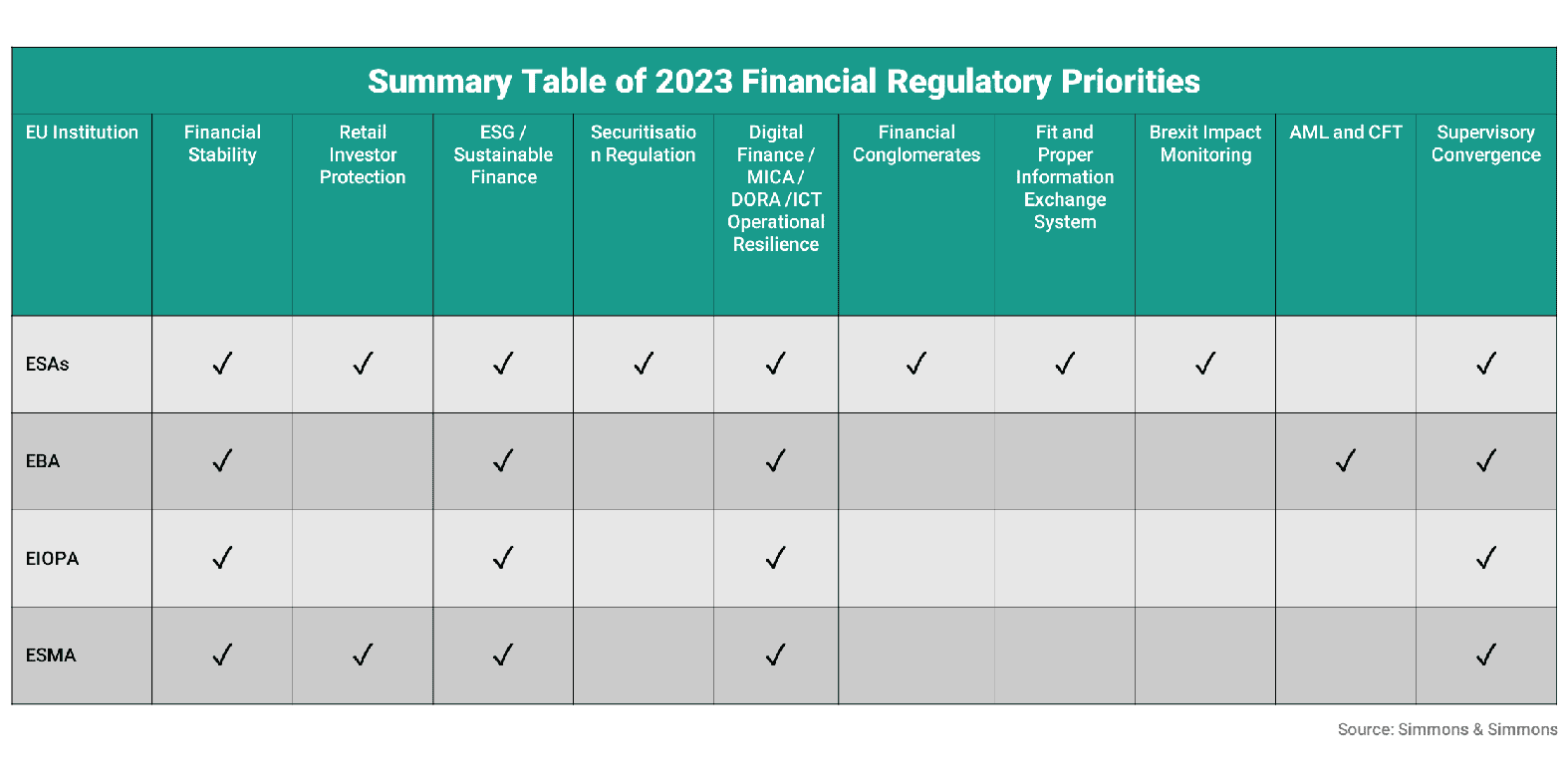
But one focus lies on the financial sector. 2023 sees several priorities published by EBA, EIOPA, ESMA (see table below).
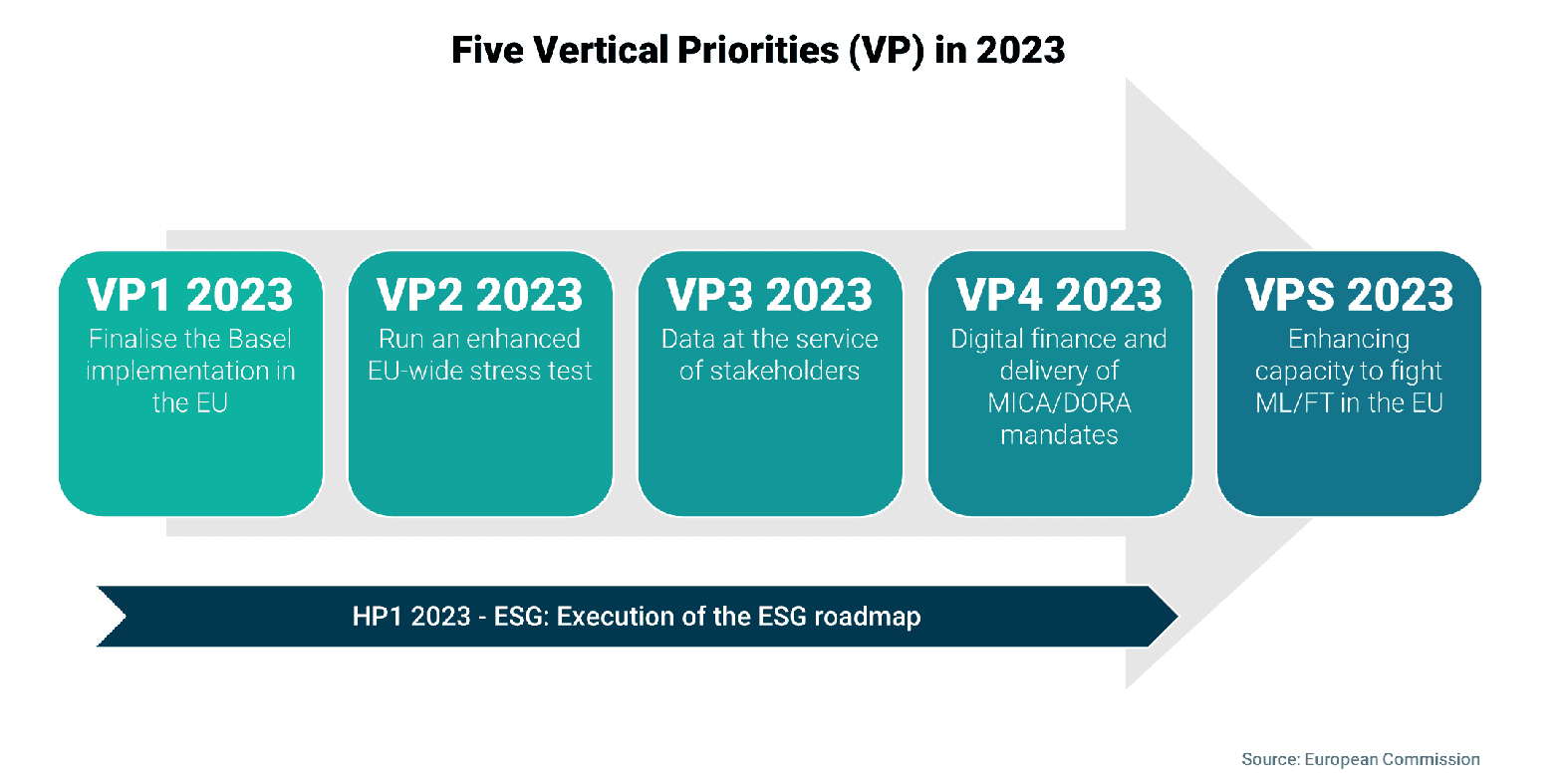
There are six strategic pillars of the EBA’s 2023-2025 strategic priorities; including addressing information and communications technology (ICT) risks and digital finance challenges while strengthening “operational resilience”.
EBA’s focus will be on:
- Finalising the Basel implementation in the EU
- Running an enhanced EU-wide stress test
- Providing data to all stakeholders
- Addressing the new challenges arising from the digitalisation of finance
- Building of the capacity to fight ML/FT as well as to protect consumers in the EU
- Focusing on the ESG agenda including its regulatory and risk assessment mandates
- Incorporation EU Eco-Management and Audit Scheme (“EMAS”)
- Discharge the new oversight responsibilities in relation to the Digital Operational Resilience Act (“DORA”) and Markets in Crypto-Assets (“MiCA”) legislations
Um nur ein Thema herauszugreifen, das wir etwas ausführlicher betrachten wollen: In der EU treten ab dem 1. Januar 2023 zusätzliche Regeln für die Offenlegung von Nachhaltigkeitsdaten in Kraft. Die ESG-Berichterstattung ist für Finanzprodukte nicht völlig neu, da sie bereits seit März 2021 in gewissem Umfang vorgeschrieben ist, wobei nur wenige Details darüber bekannt sind, was enthalten sein sollte. Die neuesten technischen Standards enthalten inzwischen sehr spezifische und komplexe Details darüber, was, wie, wann und an wen berichtet werden muss.
Während Fondsmanager und "Finanzmarktteilnehmer" (diese sind definiert als: "Vermögensverwalter, institutionelle Anleger, Versicherungsgesellschaften, Pensionsfonds usw., also alle Unternehmen, die Finanzprodukte anbieten und Kundengelder verwalten") bereits über eine gewisse Offenlegung verfügen und diese regelmäßig aktualisieren sollten, enthält die Verordnung über die Offenlegung von Informationen über nachhaltige Finanzprodukte (Sustainable Finance Disclosure Regulation - SFDR) eine Anforderung für komplexere und detailliertere Informationen. So müssen laut SFDR "Finanzmarktteilnehmer" bis zum 30. Juni eines jeden Jahres einen separaten Abschnitt auf ihrer Website veröffentlichen, der wie folgt lautet "Erklärung zu den wichtigsten negativen Auswirkungen von Anlageentscheidungen auf Nachhaltigkeitsfaktoren". Die Erklärung muss den Zeitraum vom 1. Januar bis zum 31. Dezember des vorangegangenen Jahres abdecken. Sie muss auf dem neuesten Stand gehalten werden und das Datum der Veröffentlichung und der Aktualisierungen klar angeben. Die SFDR legt den genauen Inhalt fest, der offengelegt werden muss, sowie die Methodik und die Regeln für die Präsentation. Die Verordnung ist 50 Seiten lang und wird durch fünf separate Anhänge ergänzt, die Vorlagen für die Offenlegung enthalten.
Die Vorlagen in jedem Anhang sind etwa 6 Seiten lang.
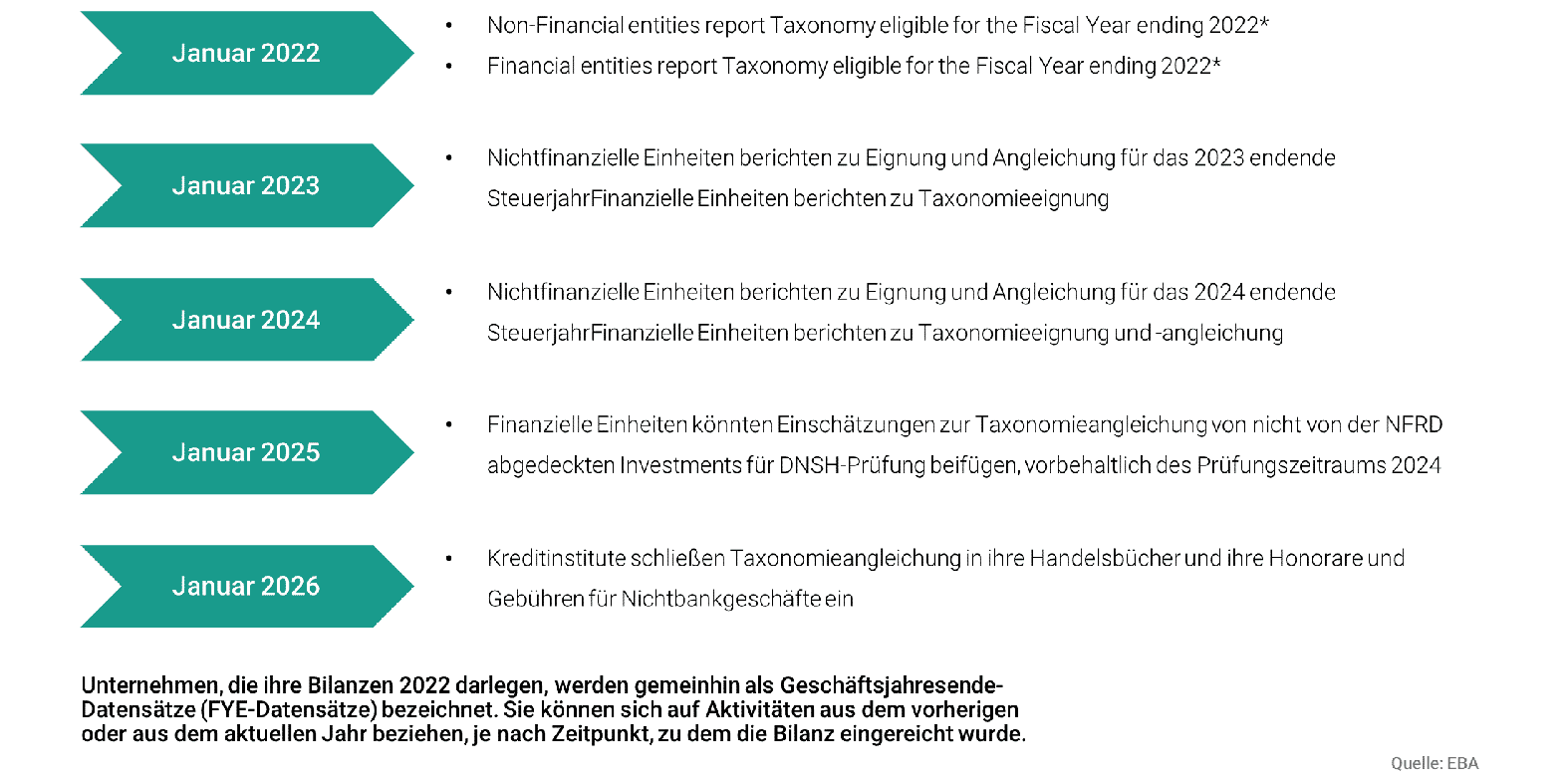
Doch das ist noch nicht alles, denn es kommen noch weitere Vorschriften hinzu, zum Beispiel zur Transparenz der Taxonomie
Erfahren Sie mehr darüber, wie Sie in [Europa Vorschriften navigieren können ].
Die wichtigsten Erkenntnisse: Infront's Sicht auf kommende Regulierungen
- Für das Jahr 2023 und darüber hinaus stehen in Europa eine Reihe neuer Vorschriften an. Anleger können sich jedoch einen Vorsprung verschaffen, indem sie verstehen, was auf sie zukommt, und die von den Aufsichtsbehörden bereits veröffentlichten Details lesen
- Zu den Schwerpunktbereichen für die Regulierung in den kommenden Monaten gehören Nachhaltigkeit und digitale Dienste und Märkte
Wenn Sie mehr über die kommenden Verordnungen für 2023-24 erfahren möchten, können Sie hier weiterlesen
A European Green Deal – European Commission
Shaping Europe’s digital future – European Commission
EBA publishes its work programme for 2023 – EBA
Preparing for 2023 and Beyond EU Digital Markets and Services Regulations – Squire Patton Boggs
EU institutions financial regulatory priorities for 2023 – Simmons & Simmons
Top five trends in UK and EU regulation for 2023 – Herbert Smith Freehills
The Digital Operational Resilience Act
Doing more with less: Compliance under pressure in 2022 & 2023