

23 MARCH 2026
Why Brokers and Publishers Are Rethinking Commodity Data Costs

Conflict in the Middle East, persistent uncertainty over global energy supply and continued sanctions pressure on major oil-producing nations have kept crude, gas and gold prices moving in ways that matter to anyone whose business depends on displaying or acting on that data.
Right now, that means a lot of firms are paying close attention.
And some of them are asking whether they are paying too much to do it.
The Cost of Going Direct
Accessing real-time commodity prices from primary exchange sources comes with a licence fee. That fee covers the right to use, display or distribute the data.
For organisations that need Brent crude, natural gas, gold and a range of other actively traded commodities, those fees add up fast. It is a growing cost pressure across the sector. Major exchanges have raised fees on commodity data licences repeatedly in recent years, introduced charges for data categories that were previously included, and restructured licensing terms in ways that consistently push costs upward.
For a broker displaying live commodity prices, or a financial publisher running a data feed, this is not a minor overhead. It is a cost that compounds over time, and one that tends to go in one direction.
But there is a credible alternative.
A Smarter Route to the Same Data
Infront has developed its own calculation methodology across hundreds of instruments that removes the need for a direct licence from the original source.
Rather than sourcing spot prices directly from primary exchanges, Infront takes futures contract prices and uses them to calculate current price indications for the most actively traded commodities. This works because near-term futures prices closely track the current spot price of the underlying asset.
The relationship between the two is mathematically consistent and has been proven robust and accurate across periods of significant market volatility, including the sharp commodity price moves seen across 2024 and 2025.
The result: commodity price indications that are 99.98% accurate compared to the primary source price, at a significantly lower cost than a direct exchange licence.
Coverage spans the commodities that matter most to European brokers, banks and financial publishers: crude oil, natural gas, gold, silver, palladium, cocoa, wheat, sugar and more. Indications are also available for indices, equities and foreign exchange.
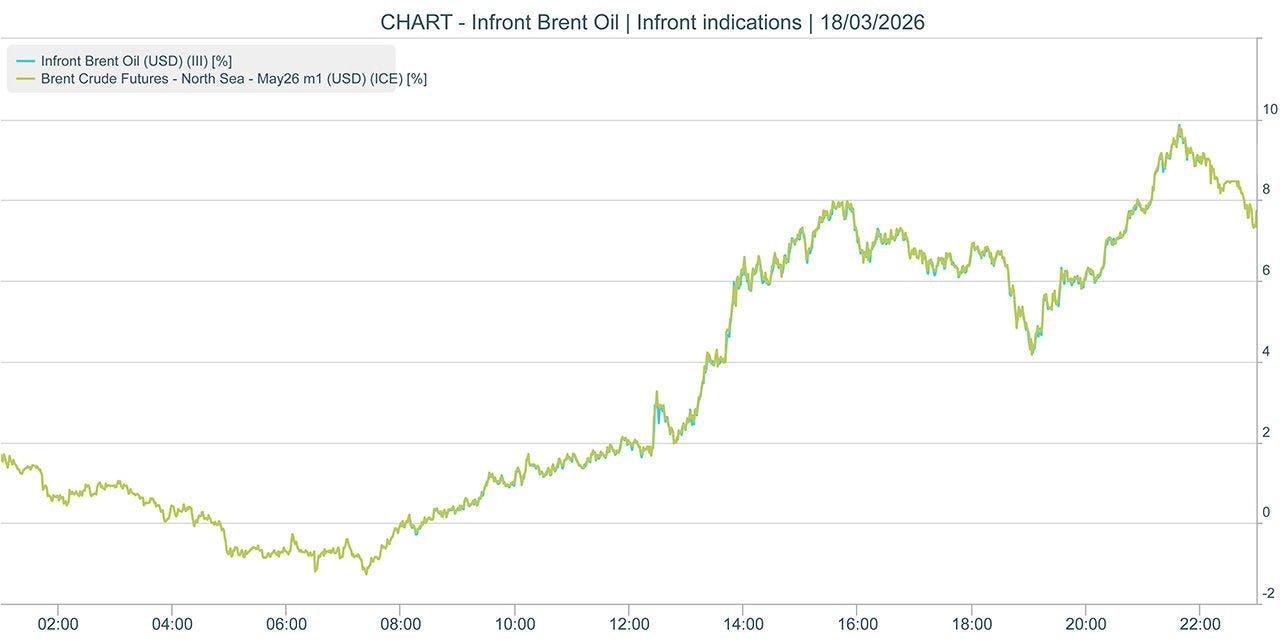 Spot the blue line... Comparing real-time price feeds of Infront Brent Oil (blue) and Brent Crude Futures exchange data (green)
Data Delivered Your Way
With Infront, indications data is available as real-time streaming, end-of-day and intraday charts with historical time series.
Infront terminal users can access commodity price indications within the terminal itself, keeping real-time pricing, analytics and trading workflows together in one place. Firms that need to push the data into their own platform, front-end or application can access it via Infront's data feeds (streaming, snapshot and end-of-day).
A bank incorporating commodity indications into an advisory tool has different requirements to an online broker running a live trading platform, or a financial publisher keeping a live data dashboard updated. Infront can serve all use cases through its flexible APIs.
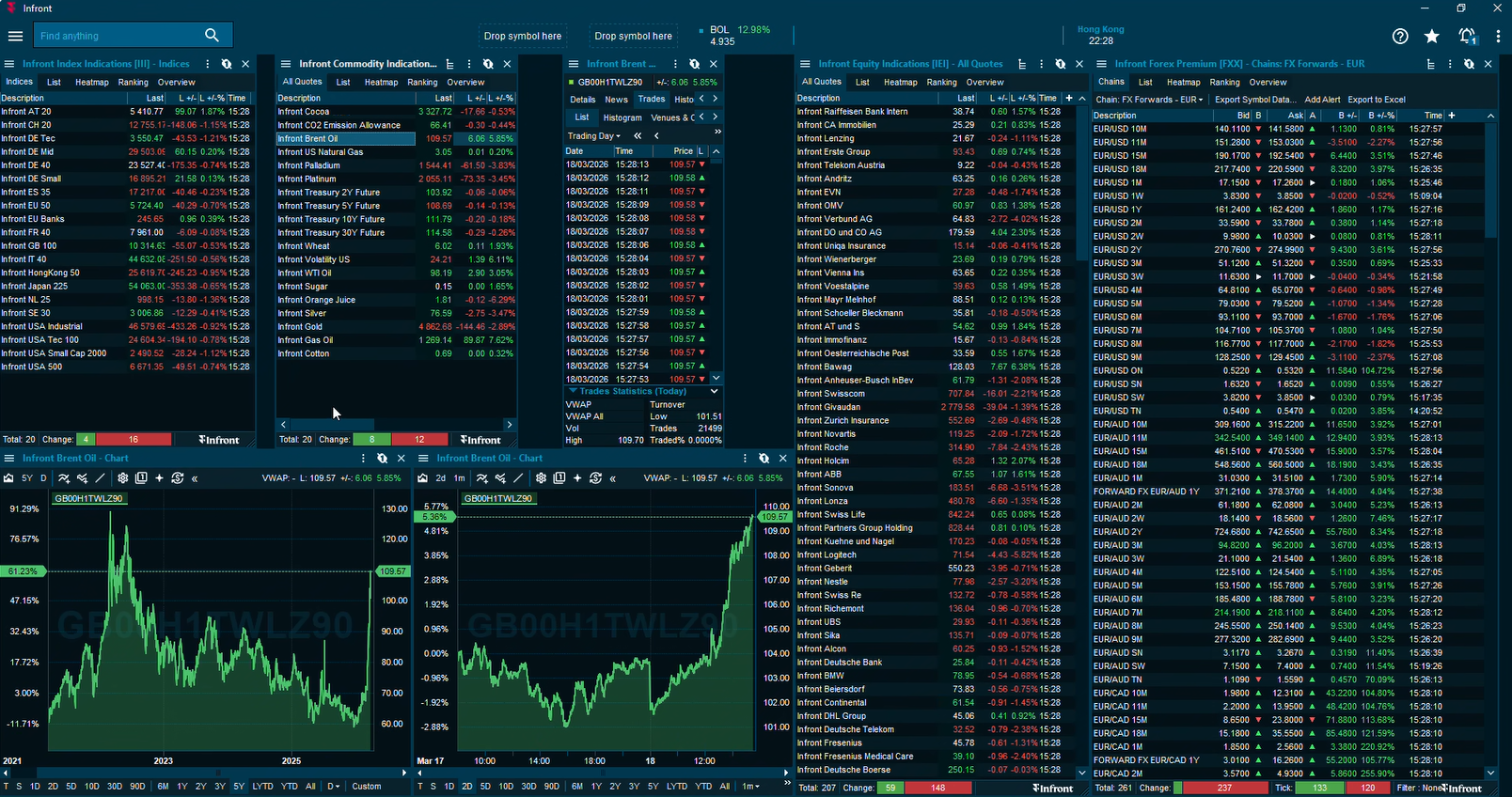 Infront terminal showing commodities and index indications data
Volatile Markets Raise the Stakes
The current environment has made commodity data more commercially important than it has been for some time.
The recent Middle East conflict and disruption of shipping through the Strait of Hormuz caused oil prices to rise from under $70 per barrel to over $100 in a matter of days. Fast-moving prices expose every weakness in a data setup: latency, gaps in coverage, accuracy. For financial organisations or publishers that cannot show or act on live prices during volatility, what starts as a display problem quickly becomes a credibility problem with their own clients.
Across 2025, energy prices and other globally traded commodities saw elevated volatility driven by economic uncertainty and geopolitical tensions. That is unlikely to settle quickly.
The research backs this up. Oxford Economics has noted that geopolitical risk is "increasingly acting as a persistent pricing factor rather than a transitory shock," with markets now embedding a standing risk premium reflecting ongoing supply-chain fragility and trade fragmentation. The volatility that has defined commodity markets in recent years is not noise. It is the new baseline.
The pressure on data costs is running in parallel. As licensing frameworks tighten across the industry, a methodology-based alternative that is accurate, broad in coverage and lower in cost makes a compelling case at every level of the business.
Ready to Cut Your Commodity Data Costs?
For brokers, publishers and banks, the proposition is straightforward: accurate commodity price indications across the instruments that matter most, at a fraction of the cost of going direct to source. If your current data setup is costing more than it should, it is worth a conversation.